Skip to content
HDC Consultancy.
Industry showcase · Managed IT & IT support providers

A managed IT website that stays correct after you hand it over

Most IT support websites rot. Services change, bundles get renamed, a price moves, and six months later three pages disagree with each other. This one was built so there is only one place to make that change, and tests that fail the build if something important drifts.

29 pages live, generated from one content file
Get a free consultation

Built for people like

  • Managed service providers and IT support firms
  • Cyber security and cloud providers
  • IT companies selling bundled service tiers
  • Firms whose site drifts out of date after launch
  • Anyone handing a site back to a non-technical team
stiperstone.uk Live
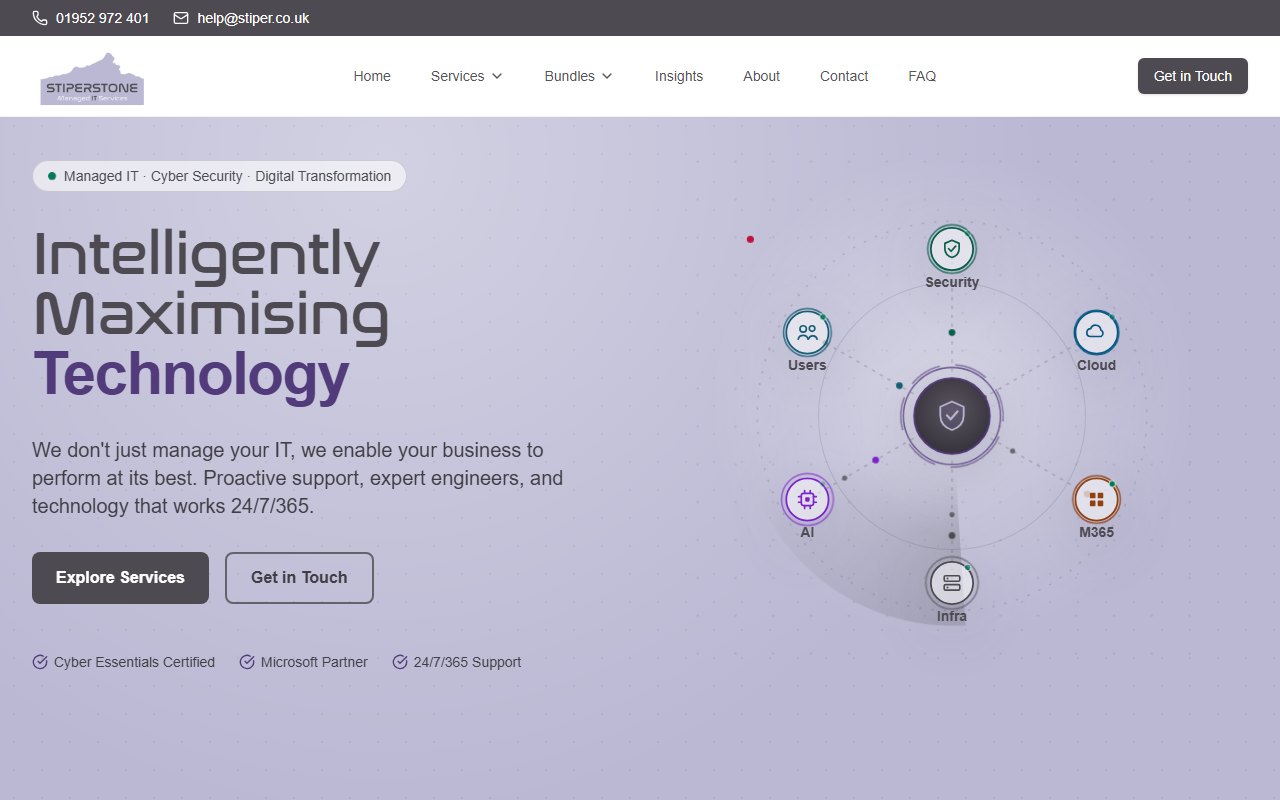
Stiperstone Managed Services website, designed and built by HDC Consultancy

The real site, loading live. Open stiperstone.uk

The 30-second version

The client
Stiperstone Managed Services, the managed IT, cyber security and cloud division of Stiperstone Group, selling to UK SMEs.
The problem
A React single-page app inherited from Hostinger Horizons, with service and bundle content scattered through page markup where it could not be safely maintained.
What we built
29 static Astro pages generated from one content file, React islands only where interaction genuinely needs them, and unit tests over the data, the schema, the icons and the contact payload.
The outcome
A site where changing a service is one edit in one file, and where a broken change fails the build rather than reaching a prospect.

What it changed

29
pages live, generated from one content file
1
file to edit to change any service, bundle or FAQ
4
test suites guarding data, schema, icons and the contact payload
0
content edits that require touching page markup
Visit the live site

The start: a single-page app selling a responsiveness promise

Stiperstone Managed Services sells managed IT, cyber security and cloud to UK SMEs. The proposition is responsiveness: when something breaks, somebody answers.

The site it had was a Hostinger Horizons export, a React single-page app that assembled itself in the browser. Every service, every bundle, every FAQ was written into page markup. It worked, in the sense that it displayed. But it was slow to arrive, awkward for search engines to read, and structurally impossible to maintain without a developer.

The problem with content living in markup

Websites do not go out of date because time passes. They go out of date because somebody edits them.

When a service name is written into nine different page files, a rename updates seven of them. The other two sit there for a year, quietly contradicting the rest of the site, until a prospect notices and asks which version is true. Multiply that across services, bundles, prices, FAQs and stats, and a site that launched accurate is wrong within a year.

The middle: what we actually built

1. Put every piece of content in one file

Company information, services, bundles, sector bundles, FAQs, testimonials and statistics all live in a single data file. The pages read from it. Nothing is written twice.

Changing a service name is one edit. Adding an FAQ is one edit. The 29 pages regenerate from the same source, so they cannot disagree with each other, because there is only one of each fact.

2. Write tests for the content, not just the code

Four test suites run against the build. They check the data is the shape the pages expect, that the structured data is valid, that every icon referenced actually exists, and that the contact form payload still matches what the endpoint receives.

That last one matters more than it sounds. The most expensive website bug is not a visual one. It is a form that looks like it submitted and quietly does not, and it is usually caused by a field being renamed on one side and not the other. A test catches that in seconds. Without one, you find out when you ask why the enquiries stopped.

3. Static pages, islands only where they earn it

Every page is server-rendered HTML. React appears in three places: the mobile navigation, the contact form and the group cards. Everything else is markup and small vanilla scripts.

4. Make the tiers comparable

Service bundles are laid out so a buyer can see what they get at each level and place themselves before contacting anyone. This is a small content decision with a disproportionate commercial effect: it removes the enquiries that were only ever going to discover you were out of range, and it makes the remaining first calls much shorter.

5. Build the machine layer in from the start

llms.txt, per-route structured data, organisation and location markup. For a managed service provider this is no longer optional. A meaningful share of supplier shortlists now begin with somebody asking an AI assistant who provides IT support in their area, and assistants read structured content, not design.

The end: what it left them with

29 static pages generated from one file, with tests standing between a careless edit and a live mistake. The site is handed back in a state where changing a service is genuinely a one-line job, which is the difference between a website that stays true and one that slowly becomes a liability.

What a site like this includes

Everything below is either live on this build today, or a popular add-on we build for this industry. Nothing theoretical.

In this build

One file for all content

Company details, services, bundles, sector bundles, FAQs, testimonials and stats all live in a single data file. Edit there, never in the markup.

In this build

Tests that guard the content

Four suites check the data shape, the structured data, the icon set and the contact form payload. A rename that breaks a reference stops the build.

In this build

Static pages, islands where needed

Server-rendered HTML throughout, with React used only for the mobile nav, the contact form and the group cards.

In this build

Service tiers people can compare

Bundles presented so a buyer can tell what they get at each level without ringing to find out.

In this build

A machine layer that is actually there

llms.txt, per-route JSON-LD and location markup, so the firm resolves properly in both search and answer engines.

In this build

Self-hosted fonts and images

No third-party font call on first paint. Small thing, visible result, and one fewer external dependency.

Want a different mix? Every build is scoped to your business at a free consultation — see transparent pricing.

Questions from businesses like this

What should a managed IT support website include?

A page per service rather than one list, service tiers a buyer can compare without ringing you, honest detail on response times and support hours, and accreditations that are real and current. Managed IT is bought on the belief that you will answer when something breaks, so anything that demonstrates responsiveness is worth more than anything that describes it.

Why does it matter where the content lives?

Because sites decay through editing, not through age. If a service name appears in nine places in the markup, somebody will eventually change seven of them. Putting all of it in one file means the change happens once and propagates, and the tests catch it if a reference breaks.

Do IT companies need a fast website specifically?

More than most. Every other sector gets judged on its product. An IT provider gets judged partly on its own website, because that is the only piece of your technical work a prospect can inspect before they buy. A slow, broken site is an argument against hiring you.

Should we show our prices?

Show the shape of them. Full price lists rarely survive contact with real scoping, but tiers with what is included at each level let a buyer place themselves before they contact you. That filters out the mismatches and makes the first call much shorter.

What happens when we want to change something?

Open one file, change the value, push. The pages regenerate. For anything structural we are a message away, but day-to-day content was deliberately built so it does not need us.

The Complete Setup

Or have us build the whole thing

Website, CRM, automations, AI chatbot, email marketing, Google and Meta ads, branding and hosting — built and wired together by one team, so you can get on with running the business.

~5 a day

enquiries from search

£0

spent on ads to get them

400+

pages answering real searches

1 form

enquiry to signed application

Fast Track Leasing, on this exact stack. Your market will differ — we'll tell you how before you commit.

Price on application — scoped per business.

Want a site like this for your business?

Book a free consultation and let's discuss your vision — no jargon, no pressure, and Harry will be in touch personally.

What are you looking for?

Get your free consultation
5.0
Call us