The start: one owner, three propositions, no structure
Stiperstone Group sells managed IT support, cyber security and compliance, and enterprise business transformation. Those are three different conversations. The person who wants a help desk that answers the phone is not the person running a transformation programme, and neither of them is the person filling in a client security questionnaire at eleven at night.
The group had the brands. What it did not have was a structure that let each one be found without the others getting in the way. Everything had come off a Hostinger Horizons export, a React single-page app that rendered its content in the browser, which is close to the worst possible starting point for a business that needs to be found in search.
The problem nobody mentions until it is too late
Multi-brand groups have a specific failure mode. The parent company site, wanting to look substantial, writes its own page about every service the group offers. Now the group site and the division site are both competing for “cyber security Shropshire”, and Google has to choose. It usually chooses neither, because the signals are split across two pages that each look like a partial answer.
We see this constantly, and it is almost always accidental. Nobody sets out to compete with themselves. They just write a services page on the parent site because every website has a services page.
The middle: what we actually built
1. Decide what the parent is for, before writing a word
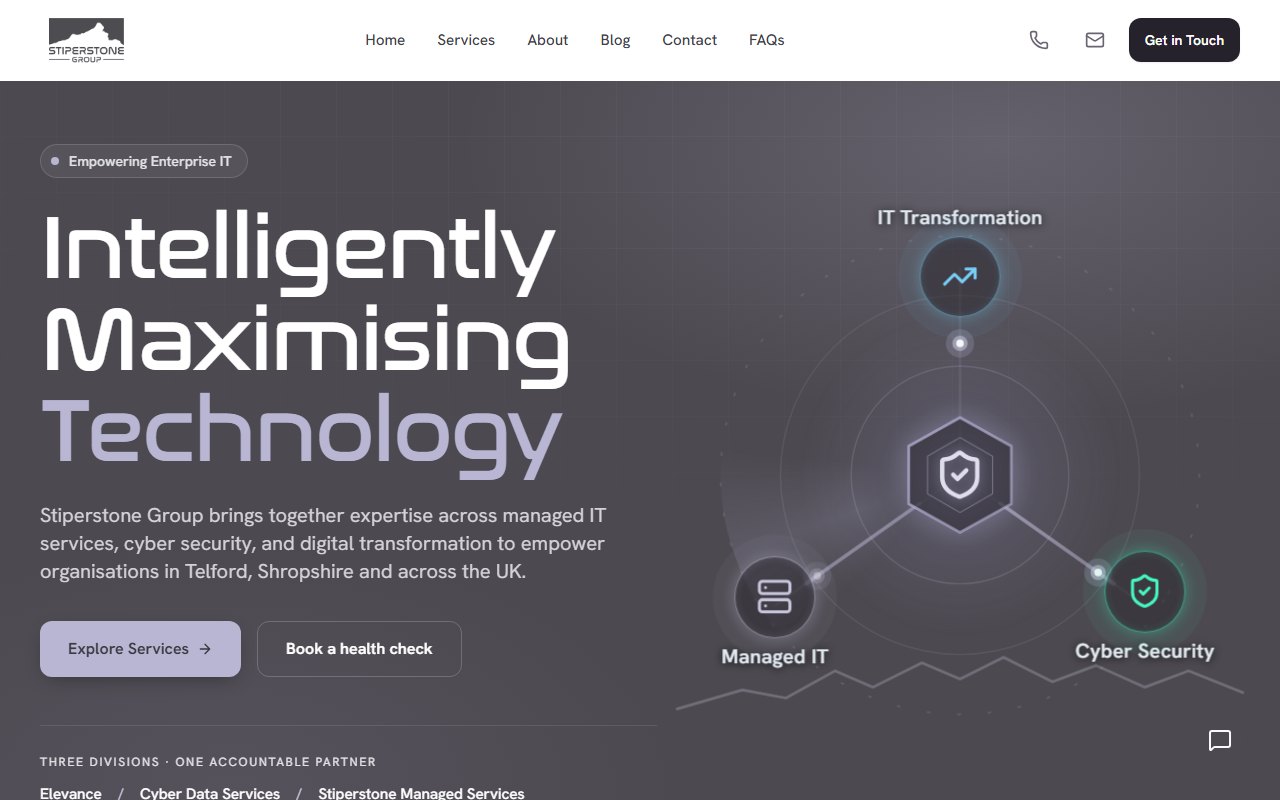
The group site answers three questions and then gets out of the way: who is this group, what do the divisions do, and which one do I need. That is it. Thirteen pages. No service pages competing with the divisions, no location pages chasing terms Cyber Data Services needs.
The footer says it plainly: three divisions, one accountable partner. That is the group’s actual proposition, and it is one no individual division can make.
2. Give each division its own domain and its own job
Elevance took enterprise transformation on elevance.co. Cyber Data Services took security and compliance on cyberdataservices.uk. Stiperstone Managed Services took day-to-day IT support on stiperstone.uk. Each owns its services outright. The parent links to them; it does not reproduce them.
3. Ship nothing the browser has to assemble
The group site is static Astro. Every page arrives as finished HTML. The mobile drawer, the FAQ accordions, the cookie banner and the forms are small vanilla scripts, so no framework reaches the browser at all.
For most clients that is a performance decision. For an IT group it is also a credibility one. A prospect assessing whether you can run their infrastructure will, at some point, open your website on their phone. That is a work sample whether you meant it to be or not.
4. Make the group resolve as a real entity
The structured data names the organisation, its people, its contact points and its opening hours, and places it in Telford and Shropshire. Combined with llms.txt across the estate, that gives both search engines and answer engines something concrete to resolve rather than a brand name floating free.
This matters more every year. A growing share of supplier shortlists now start with somebody asking an assistant who does managed IT in Shropshire, and assistants answer from the machine layer, not from the hero image.
5. Build four sites the same way
Same stack, same components, same deployment. Four sites built as one programme stay consistent and cost less than four built from scratch, and when something needs fixing it gets fixed once rather than four times in four slightly different ways.
The end: what it left them with
Four live sites, 134 pages between them, each brand with its own domain, its own proposition and its own search terms. The parent site is the smallest of the four and that is the point: it is there to position the group and hand people on, not to compete with the businesses it owns.